
ESP8266 ESP-01S
4.4Editor score
Affordable Serial Transceiver
4MB Flash Memory Storage
Compact and Reusable Design
This guide compares the top Arduino WiFi modules for connectivity performance, compatibility, and ease of use to help you choose the right wireless solution
Selecting the right Arduino WiFi module is essential for any project requiring internet connectivity. Whether you are building smart home devices or industrial sensors, reliable wireless communication ensures your data reaches the cloud efficiently and securely.
We have evaluated ten leading Arduino WiFi solutions based on their technical specifications, user feedback, and integration capabilities. This list covers everything from basic transceiver modules to advanced boards with built-in processing and modern connectivity options.
Each pick highlights specific strengths such as dual-core processing, Bluetooth support, or cost-effective serial communication. Keep in mind that product availability and pricing can fluctuate, so verify current details before making your final purchasing decision.
4.4Editor score

4.7Editor score

4.5Editor score
The following table provides a side-by-side comparison of all ten selected Arduino WiFi modules. It highlights key specifications and features to help you quickly identify the best fit for your specific application needs.



The Arduino UNO R4 WiFi stands out as the premier choice for advanced projects requiring robust connectivity and processing power. With a high rating from users, it delivers exceptional performance for both hobbyists and professionals seeking reliable wireless capabilities.
We may earn a commission when you buy through this link, at no additional cost to you.
Its dual-core architecture combines the Renesas RA4M1 and ESP32-S3 chips, enabling high-speed communication and real-time data processing. The integrated 12×8 LED matrix provides immediate visual feedback without external components, while the 12-bit DAC and OP-AMP support precise analog signal generation.
While the board offers extensive features, it comes with a higher price tag compared to basic modules. The larger physical size may also be a constraint for space-constrained projects, though the benefits of integrated wireless and processing often outweigh these trade-offs.
This board is ideal for users building complex IoT systems, smart home hubs, or industrial automation projects. If you need reliable Wi-Fi and Bluetooth with advanced analog features, this is the top recommendation for your next build.
The inclusion of CAN bus and Qwiic connectors simplifies industrial and sensor integration tasks significantly.
The built-in LED matrix allows for status indication and data display directly on the board.
We may earn a commission when you buy through this link, at no additional cost to you.
The HiLetgo 3pcs ESP8266 package offers a cost-effective way to add wireless connectivity to your projects. Users appreciate the reliable performance of the ESP8266 chip which handles data transmission efficiently in various modes.
We may earn a commission when you buy through this link, at no additional cost to you.
This module supports AP, STA, and combined modes allowing flexible network configurations. The on-board processing capabilities ensure that complex tasks can be handled without overloading your main microcontroller, making it a versatile choice for intermediate users.
Despite its strengths, the module lacks advanced features like Bluetooth or USB-C connectivity. It requires careful voltage management as it operates at 3.3V which can be tricky for beginners used to 5V logic levels.
Ideal for hobbyists needing multiple units for different prototypes, this pack provides great value. If you require basic Wi-Fi transmission for sensor data or remote control, this is a solid and economical option.
Support for AP and STA modes allows the module to act as either a client or access point.
The ESP8266 chip handles its own Wi-Fi tasks reducing load on the main Arduino board.
We may earn a commission when you buy through this link, at no additional cost to you.
The ESP8266 ESP-01S is a top choice for those seeking the most affordable WiFi solution without sacrificing core functionality. Its 4MB flash memory offers ample space for storing data and scripts during operation.
We may earn a commission when you buy through this link, at no additional cost to you.
Users report that this version has a stronger signal compared to earlier models ensuring better range and stability. This makes it suitable for projects where connection reliability is critical even when the module is placed away from the router.
The main challenge lies in its power requirements and the need for level shifting or specific voltage regulation. It also requires specific settings in the Arduino IDE to function correctly which may confuse novice programmers initially.
Best for budget-conscious developers who understand the hardware requirements this module delivers excellent performance per dollar. It remains a favorite for small scale IoT deployments where cost is a primary concern.
The improved antenna design ensures better connectivity in noisy environments.
With 4MB flash users can store more complex configurations and data logs.
We may earn a commission when you buy through this link, at no additional cost to you.
The Aitrip 5pcs ESP8266 bundle provides a generous supply of wireless modules for extensive prototyping projects. Each unit supports the standard ESP8266 protocol ensuring compatibility with a wide range of development tools.
We may earn a commission when you buy through this link, at no additional cost to you.
Users find these modules reliable for smart grids and industrial control applications where cost-effective connectivity is key. The support for AT commands allows for easy configuration and testing without needing full firmware uploads.
A critical note is the strict voltage requirement of 3.3V meaning a 5V source cannot be connected directly without damage. This necessitates careful power management which might be a hurdle for those unfamiliar with logic level conversion.
Perfect for teams or schools needing multiple units for classroom projects this pack ensures everyone has a module to work with. It is a practical choice for large scale testing and development workflows.
AT commands simplify network setup and debugging without heavy code compilation.
Having five modules allows parallel development of different network prototypes.
We may earn a commission when you buy through this link, at no additional cost to you.
The ELEGOO 3PCS ESP-32 boards deliver high performance with their dual-core processors capable of running at up to 240 MHz. This makes them ideal for tasks requiring significant computational power alongside wireless connectivity.
We may earn a commission when you buy through this link, at no additional cost to you.
Users appreciate the inclusion of Bluetooth alongside Wi-Fi allowing for richer device interaction. The USB-C port simplifies power and programming connection while the power-saving modes help extend battery life in remote sensors.
While these boards are feature-rich they require a USB-C cable which might not be included. The price is higher than standard modules but the added processing power justifies the investment for complex IoT solutions.
Best for projects needing real-time data processing and wireless flexibility this board handles automation logic well. It is a strong contender for developers looking to move beyond basic microcontroller limitations.
One core can handle wireless tasks while the other processes sensor data.
USB-C ensures reliable power delivery and faster programming speeds.
We may earn a commission when you buy through this link, at no additional cost to you.
The Arduino Nano ESP32 is a premium board designed for modern IoT development requiring high performance and flexibility. Its ESP32-S3 chip offers superior processing capabilities for edge computing and machine learning tasks.
We may earn a commission when you buy through this link, at no additional cost to you.
Developers appreciate the MicroPython compatibility which speeds up prototyping and allows for interactive coding sessions. The board also supports HID profiles enabling the creation of custom input devices like keyboards and mice directly.
The main drawback is the lack of pre-installed headers which requires soldering for breadboard use. Additionally the compact form factor means less space for wiring but this can be managed with proper planning.
Ideal for advanced users wanting Python support and modern connectivity this board is highly recommended. It bridges the gap between simple microcontrollers and powerful development systems effectively.
MicroPython support allows for faster iteration and easier scripting of IoT logic.
HID support enables the board to act as a USB peripheral without extra hardware.
We may earn a commission when you buy through this link, at no additional cost to you.
This pack of four ESP8266 ESP-01S modules offers excellent value for repetitive prototyping needs. Users highlight the durable construction that allows for multiple uses across different project cycles.
We may earn a commission when you buy through this link, at no additional cost to you.
The self-calibrated RF technology ensures optimal performance across various environments. This consistency is critical for reliable data transmission in sensor networks and home automation setups.
While robust the modules still require careful power handling due to voltage constraints. They are best used with regulated power supplies to prevent instability during transmission.
Best for educators or developers needing reliable backups this set provides peace of mind. It is a practical solution for ensuring you always have a functioning module available for testing.
Self-calibration ensures consistent signal quality across different batches of modules.
Durable materials allow these modules to be reused across many different projects.
We may earn a commission when you buy through this link, at no additional cost to you.
The 5PCS ESP8266 ESP-01S bundle is a favorite for IoT projects needing ample storage and reliable communication. Each module comes with 4MB flash memory allowing for substantial data logging without external memory.
We may earn a commission when you buy through this link, at no additional cost to you.
Users praise the 115200 baud rate which ensures fast data transmission over serial lines. The DOUT protocol support requires correct configuration but offers robust performance once set up properly.
As with many modules strict voltage requirements mean attention must be paid to power sources. Overvoltage can damage the unit so using a dedicated 3.3V regulator is highly recommended.
Ideal for developers working on data-heavy applications this bundle provides reliable units with extra storage. It is a solid choice for commercial prototypes requiring consistent data handling.
The standard 115200 baud rate ensures rapid data exchange with the host.
4MB flash allows storing firmware and logs locally for offline operation.
We may earn a commission when you buy through this link, at no additional cost to you.
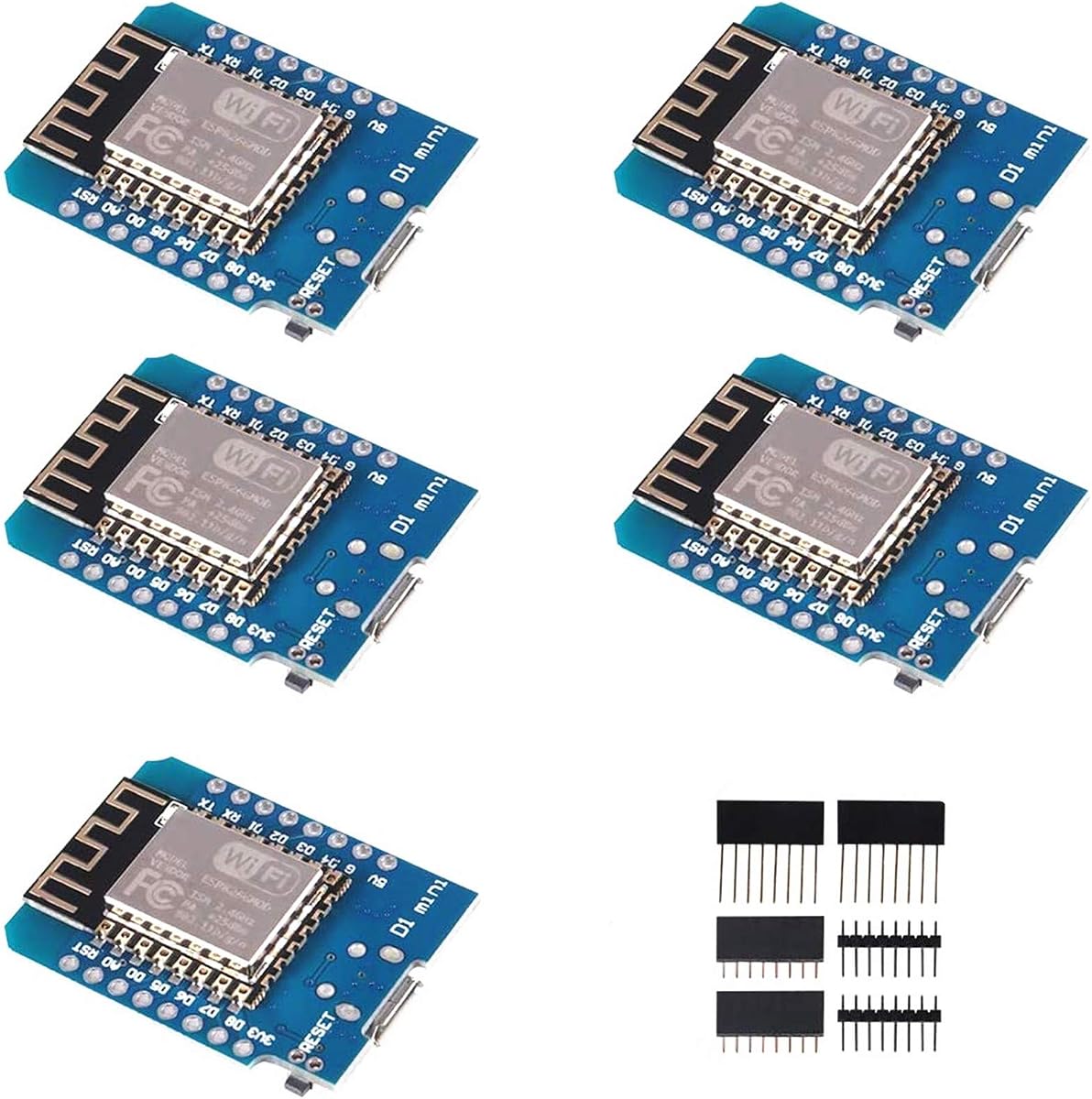
This bundle offers five compact ESP-12F modules that provide easy access to Wi-Fi capabilities through USB and serial connections. Users appreciate the mini form factor which fits into tight spaces easily.
We may earn a commission when you buy through this link, at no additional cost to you.
The inclusion of 11 digital I/O pins makes these more versatile than bare modules requiring less external circuitry. The built-in voltage regulator simplifies power management making them friendly for beginners.
While the micro USB connection is useful it is less durable than modern USB-C ports. The 1MB flash is sufficient for most scripts but may limit larger applications compared to 4MB variants.
Best for wearable electronics and small devices this pack offers great convenience. It is an excellent choice for quick prototyping where space and ease of connection are priorities.
Built-in voltage regulators make powering the module straightforward from USB.
Mini boards fit easily into tight enclosures for portable devices.
We may earn a commission when you buy through this link, at no additional cost to you.
The 10-Pack ESP8266 ESP-01 bundle provides a massive supply for large teams or extensive production needs. Users rate this product highly due to consistent performance and reliable connectivity across all units.
We may earn a commission when you buy through this link, at no additional cost to you.
The modules feature robust on-board processing which handles complex algorithms efficiently. Support for AP and STA modes ensures flexibility in network design whether acting as a client or server.
Given the bulk nature this pack is best for those who plan to distribute modules widely. It might be too much for individual hobbyists but ideal for corporate or educational procurement.
Ideal for organizations needing dependable wireless hardware this set offers consistent quality. If you require a large number of stable modules for testing or deployment this is the best value.
High user ratings indicate consistent quality across the entire ten-unit batch.
AP and STA modes allow the module to serve various networking roles.
We may earn a commission when you buy through this link, at no additional cost to you.
Choosing the right WiFi module involves considering connectivity, power, and compatibility with your existing setup.
Different modules offer various wireless capabilities such as Wi-Fi only or combined Wi-Fi and Bluetooth. Consider whether your project needs dual connectivity for remote control via smartphones or just simple internet access for data logging.
Always select a module that matches your specific communication needs to avoid unnecessary complexity or missed features.
Voltage levels are critical as some modules operate at 3.3V while others support 5V. Mismatching voltage can damage your microcontroller or cause unstable behavior during operation.
Check the voltage specs carefully and ensure your power supply or logic level shifter is compatible with the module.
Storage capacity affects how much code or data you can store locally. Modules with larger flash memory support more complex firmware and data logging capabilities without external storage.
For advanced applications prioritize models with at least 4MB of flash memory to ensure flexibility.
The physical connection method varies from USB-C to Micro USB to serial headers. A modern USB-C port simplifies programming and power delivery but might add to the cost.
Choose an interface that matches your development workflow and available cabling to streamline setup.
Some boards include dual-core processors which allow parallel processing of tasks. This is vital for projects requiring real-time data handling alongside wireless transmission.
Opt for dual-core options if your project involves heavy computation or complex logic processing.
User-friendly features like built-in headers or pre-installed libraries reduce setup time. Consider the learning curve for the specific microcontroller environment like MicroPython or C++.
Modules with extensive documentation and community support make troubleshooting much easier for beginners.
Physical size determines how easily the module fits into your enclosure. Compact boards are better for wearables while larger ones might offer better heat dissipation and pin accessibility.
Measure your project space before selecting to ensure a proper fit and efficient use of resources.
Buying in packs can reduce the cost per unit significantly. For teams or bulk projects, multi-packs offer better value than single purchases.
Evaluate how many units you need before committing to a pack size to avoid waste or shortage.
Always verify voltage compatibility before connecting the module to your microcontroller. Use level shifters if needed to prevent damage to sensitive pins during data exchange.
Maintain good ventilation around the module during long operation periods as wireless transmission generates heat. Keep the module away from water sources to avoid short circuits.
Update firmware regularly to ensure security and performance stability. Store spare units properly to avoid physical damage to the exposed pins.
No, not all modules support Bluetooth. Basic ESP8266 models typically handle Wi-Fi only. If you need Bluetooth, look for modules like the ESP32-S3 or Arduino UNO R4 WiFi which include dual connectivity support.
You must use a voltage regulator or logic level shifter to step down the signal. Directly connecting 5V to a 3.3V module can cause permanent damage to the circuitry.
Yes, certain modules like the Arduino Nano ESP32 are explicitly compatible with MicroPython. Others may require specific firmware flashing to enable Python-based development environments.
In AP mode the module acts as a Wi-Fi access point allowing devices to connect to it. In STA mode it connects to an existing network like your home router for internet access.
Common causes include incorrect SSID credentials weak signal strength or power instability. Ensure the module receives consistent 3.3V power and is positioned within range of the router.
Storage depends on the flash memory which ranges from 1MB to 4MB. For larger datasets consider using cloud storage or external SD card interfaces available on some boards.
We have reviewed ten top options ranging from budget-friendly serial modules to premium dual-core boards. Each provides unique benefits depending on your power and connectivity needs.
Prioritize voltage compatibility and processing power when making your decision. Ensure the interface matches your existing hardware to avoid integration headaches.
Always verify current availability and specifications before buying as product details can change. Select the module that offers the best balance of performance and ease of use for your project.