
TiFFCOFiO Indoor Mechanical Outlet Timer
4.4Editor score
48 ON/OFF settings
Compact design saves space
ETL listed for safety
This comprehensive guide compares the top automatic light timer options available in October 2026 to help you choose the right model for your home automation
Finding the right automatic light timer can transform how you manage energy and security at home. These devices allow you to schedule lights and appliances without manual intervention. A good timer should be easy to program and reliable enough to work consistently over time.
We have analyzed ten highly rated models based on user feedback and technical specifications. Our comparison covers mechanical and digital options as well as smart plugs that connect to your network. This list helps you understand the strengths and weaknesses of each available choice.
Each pick in this guide highlights specific features that matter for different household scenarios. You will see ratings and key specifications to help you make an informed decision. Keep in mind that product availability and details may change over time.
4.4Editor score

4.4Editor score

4.4Editor score
The following table provides a side-by-side view of the key specifications for each product. This helps you quickly identify which features align with your specific scheduling needs.



The BN-LINK U47 is a straightforward mechanical timer designed for indoor use. It comes in a two-pack and features a pin-based system for setting on and off times. Users appreciate its simplicity and reliability for automating lamps and small appliances.
We may earn a commission when you buy through this link, at no additional cost to you.
This timer allows up to 24 on and off settings per day in 30-minute intervals. It is compatible with compact fluorescent and LED bulbs as well as most small appliances. The pins are pressed down out of the box so you must pull them up to begin setting.
While it lacks a digital display or app control, the mechanical nature means it works even during power outages without needing battery backups for basic operation. Some users may find the pin system less precise than digital options.
This is an excellent choice for anyone needing a basic, no-fuss timer for indoor lights. It is ideal for holiday decorations or simple daily schedules. We recommend it for those who want simplicity over advanced features.
The push pin system makes setup intuitive without any complex programming or batteries required for basic timing functions.
It supports a wide range of lighting types including LEDs and CFLs making it suitable for most household fixtures.
We may earn a commission when you buy through this link, at no additional cost to you.
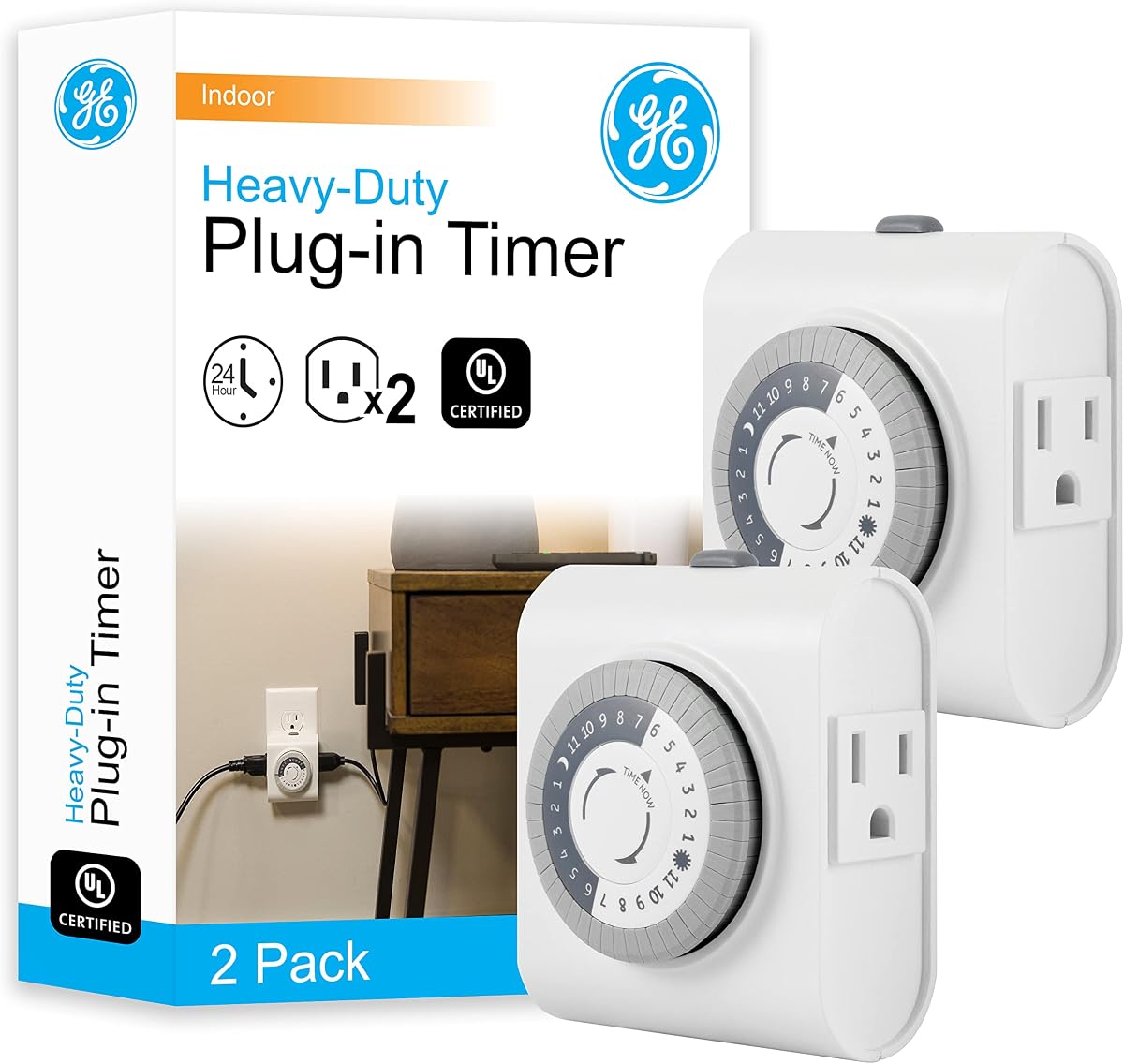
GE offers a robust 24-hour mechanical timer that includes two grounded outlets on a single unit. This design allows you to control multiple devices from one indoor receptacle. The pushpin scheduling is quick and does not require any Wi-Fi or apps.
We may earn a commission when you buy through this link, at no additional cost to you.
The dual outlets mean you can automate a lamp and a fan simultaneously without needing extra timers. A convenient override switch lets you pause the timer cycle anytime for manual control. The design is compact with a white finish that blends into home spaces.
Like other mechanical timers it is limited to a daily repeat cycle and lacks the flexibility of week-long programming. However for daily schedules it is extremely reliable and easy to manage for most users.
We recommend this for households needing dual outlets for daily automation tasks. It is a practical solution for lamps seasonal decor or small appliances. The two-pack value adds to its appeal for budget conscious shoppers.
Having two grounded outlets on one timer simplifies wiring by allowing multiple devices to share a single plug point.
The override switch provides flexibility to turn devices on or off manually without resetting the entire timer schedule.
We may earn a commission when you buy through this link, at no additional cost to you.
This digital timer from BN-LINK offers significant flexibility with up to 8 on/off programs per day. It features two grounded outlets that are controlled simultaneously. You can choose individual days or use convenient pre-set combination days for your schedule.
We may earn a commission when you buy through this link, at no additional cost to you.
A standout feature is the Random Vacation mode which helps randomize your programmed lights to make your home look lived in. The long-lasting backup battery keeps your settings even during power outages. It is ETL listed and rigorously controlled for safety.
The interface requires some initial setup compared to mechanical pins but offers precise control down to the minute. Some users might find the programming steps slightly complex if they are not familiar with digital timers.
We suggest this for anyone wanting detailed control over their lighting schedule. It is excellent for saving energy and enhancing home security. The vacation mode makes it a strong contender for travelers.
Randomizing light patterns deters potential intruders by making it seem like someone is home even when you are away.
The internal battery ensures your programmed schedules remain intact without needing to reprogram after a power outage.
We may earn a commission when you buy through this link, at no additional cost to you.
This is essentially the same 7-day digital timer as the single pack but comes in a two-pack for broader home coverage. You can easily set up to 8 on/off programs for each timer. The outlets are controlled simultaneously with settings as short as one minute.
We may earn a commission when you buy through this link, at no additional cost to you.
Each unit features a long-lasting backup battery and a convenient Daylight Savings mode switch. The handy red LED indicator turns on when the outlets are active providing visual confirmation of the timer state. It is ETL listed for quality and safety.
Buying two at once is cost-effective if you need to automate lights in different rooms or for different appliances. The programming is identical to the single unit so familiarity helps once you learn the process.
We recommend this package for families needing multiple timers. It offers the flexibility of digital scheduling with the convenience of a bulk purchase. Ideal for comprehensive home automation on a budget.
The red LED light provides a clear visual cue that the timer is currently active and power is flowing to the device.
Purchasing a two-pack often provides a lower unit cost compared to buying timers individually for larger projects.
We may earn a commission when you buy through this link, at no additional cost to you.
The GHome Smart Plug connects to your home network to allow remote control of devices. It works with Alexa and Google Assistant for hands-free voice commands. You can control outlets anywhere via the GHome Smart Life or Tuya apps.
We may earn a commission when you buy through this link, at no additional cost to you.
Schedules and timer functions let you set devices to work circularly or randomly to save energy. Group control allows you to manage multiple plugs with one tap while sharing access with family members is also possible. It requires a stable 2.4GHz Wi-Fi network.
Unlike mechanical timers this option relies on your home network which can be a dependency if connectivity is lost. However the convenience of controlling devices from your phone is a significant benefit for modern smart homes.
This plug is perfect for those already using smart home ecosystems. It is great for controlling lamps and fans remotely or setting complex schedules. We recommend it for tech-savvy users seeking convenience.
Using voice commands through popular assistants makes turning devices on or off effortless without needing to reach for switches.
Control devices from anywhere using your smartphone which is helpful for managing lights while away from home.
We may earn a commission when you buy through this link, at no additional cost to you.
This timer from TiFFCOFiO is designed to minimize size while maintaining full functionality. The output ports are positioned underneath to help save space in your outlets. It offers 48 on/off setting options in 24 hours with each pin representing a 30-minute interval.
We may earn a commission when you buy through this link, at no additional cost to you.
The timer automatically controls your devices every day based on your settings. It is ETL listed for safety and reliability. Users appreciate the compact design that does not block other sockets on the outlet strip.
While it is a mechanical timer requiring manual pin adjustments it provides consistent daily automation. Some users may find the pins require extra effort to push down or pull up compared to other brands.
We suggest this for anyone needing a space-saving mechanical timer. It is ideal for Christmas lights or indoor lamps. The two-pack option offers good value for basic automation needs.
By placing ports underneath the timer reduces the overall footprint and allows other plugs to fit nearby.
Daily repeat settings ensure your devices turn on and off at the same time every day without extra effort.
We may earn a commission when you buy through this link, at no additional cost to you.
DEWENWILS offers a digital timer with a compact and elegant design that blends with home decor. It features a large screen display and smooth sides with a frosted front. You can program three sets of daily repeat schedules easily using the four buttons.
We may earn a commission when you buy through this link, at no additional cost to you.
The timer preserves programmed settings for up to three months if power goes out and operates silently making it ideal for bedrooms. It accurately manages timing to the minute and is suitable for lamps and electronics.
While limited to 24-hour cycles the ease of use and memory function provide reliable performance. The design aesthetic makes it a preferred choice for living spaces where appearance matters.
We recommend this for users wanting a sleek digital timer. It is great for bedside lamps or living room lights. The silent operation is a key benefit for quiet environments.
The built-in memory retains your settings for up to three months during power outages so you do not lose schedules.
Unlike mechanical timers this digital unit operates without noise making it suitable for bedrooms or study areas.
We may earn a commission when you buy through this link, at no additional cost to you.
This outdoor timer from BN-LINK features a rainproof casing that protects against weather conditions. It has two grounded outlets to control pool pumps and string lights simultaneously. The simple 48-pin mechanical control makes setup straightforward without buttons.
We may earn a commission when you buy through this link, at no additional cost to you.
Rated for 15A and 1/2HP it handles landscape lighting and outdoor devices safely. The timer retains pin settings even if power fails making it ideal for patio automation. Mount it upright 2 feet above ground for best results.
While it lacks digital precision its robustness and weatherproof design make it a reliable choice for outdoor use. Some users may find the mechanical pins harder to adjust in cold weather.
We recommend this for outdoor lighting automation such as Christmas or holiday decorations. It is a sturdy option for garden lights and pool pumps. The dual outlets add practical value for outdoor setups.
The rainproof casing ensures the timer remains operational in various weather conditions protecting internal mechanisms.
Supporting 15A and 1/2HP allows this timer to handle heavier loads like pool pumps or landscape lighting.
We may earn a commission when you buy through this link, at no additional cost to you.
G-Homa provides a simple 24-hour mechanical timer with two grounded outlets for lamps and holiday lights. It features a master switch for override control and a repeat cycle that runs automatically daily. The design prioritizes ease of use.
We may earn a commission when you buy through this link, at no additional cost to you.
You set your time using the dial and let the timer handle the rest. It is a practical solution for those who need basic automation without complex features. The dual outlets allow control of two devices from one source.
This model lacks the programmable flexibility of digital timers but excels in simplicity. Some users might miss the ability to set different schedules for different days of the week.
We suggest this for seasonal lights or simple indoor lamps. It is an affordable choice for basic timing needs. The override switch adds a layer of convenience for manual control.
Two grounded outlets on one unit allow you to manage two devices simultaneously from a single electrical source.
The convenient override switch lets you manually turn devices on or off without altering the timer schedule.
We may earn a commission when you buy through this link, at no additional cost to you.
This timer includes a photocell sensor that automatically turns lights on at dusk and off at dawn. It also supports multiple countdown functions for ON times after dusk. The design is waterproof with new structure and materials for extreme weather resistance.
We may earn a commission when you buy through this link, at no additional cost to you.
You can select functions using a dial clockwise which simplifies setup. It handles 15A loads and comes with a two-year exchange or refund policy. The sensor makes it ideal for garden lights or porch lighting.
While convenient the photocell sensor relies on ambient light so positioning matters for accuracy. The waterproof casing is robust but mounting height is specified for best performance.
We recommend this for outdoor lighting where consistent dusk to dawn control is needed. It is excellent for security or decoration. The sensor feature saves manual adjustments and energy.
The built-in sensor detects natural light levels to automate devices without requiring manual time settings.
Materials and structure are designed to resist extreme weather ensuring reliable outdoor operation.
We may earn a commission when you buy through this link, at no additional cost to you.
Selecting the right automatic light timer depends on your specific needs and preferences. This guide breaks down the key factors to consider.
Mechanical timers use pins or dials to set schedules and are generally simpler and more durable without needing power for memory. Digital timers offer precise scheduling down to the minute and often include additional features like vacation modes or backup batteries. Smart plugs connect to your home network allowing remote control and integration with voice assistants.
Choose mechanical for simplicity and reliability in basic daily cycles. Opt for digital if you need weekly variations or more control. Consider smart plugs if you want remote access and voice commands.
Timers designed for indoor use may not withstand rain or extreme temperatures. Outdoor timers feature weatherproof casings and are rated for moisture and heat. Check the product specifications to ensure the timer is suitable for your intended location.
Always verify that the timer is rated for outdoor use if you plan to mount it outside. Indoor timers can fail or become unsafe in wet conditions.
Some timers provide a single outlet while others offer two grounded outlets on one unit. Dual outlets are useful for controlling multiple devices from a single electrical receptacle which saves space and cost. Consider the number of devices you need to automate.
If you need to control a lamp and a fan simultaneously look for a timer with dual outlets. This reduces the need for multiple timers and keeps your setup tidy.
Basic mechanical timers often support only 24-hour daily cycles. Digital models may allow weekly schedules with different times for weekdays versus weekends. Some timers include vacation modes to randomize settings for security when you are away.
Assess whether you need different schedules on different days. If daily consistency is enough a simple 24-hour timer will suffice. If you need more variety choose a digital model with weekly programming.
Digital timers often include a battery backup to retain settings during power outages. Mechanical timers do not need power to maintain time settings as they rely on physical mechanisms. This factor matters if you experience frequent power interruptions.
Look for timers with internal batteries if you use digital models. Ensure you know how to replace the battery when needed to maintain functionality.
Safety certifications like ETL or UL indicate the product has been tested for electrical safety. This is crucial for preventing fire hazards or electrical shorts. Always check for these marks before purchasing especially for timers used unattended.
Never use uncertified timers for high loads or overnight use. Prioritize safety certifications to protect your home and appliances.
Mechanical timers usually require physical pin adjustments which can be straightforward. Digital models may involve navigating menus and buttons for programming. Smart plugs require connecting to your Wi-Fi network and apps for initial setup.
Select a timer that matches your comfort level with technology. Simple setups are often more convenient for elderly users or those less tech-savvy.
Using automatic timers helps reduce energy consumption by ensuring lights are not left on unnecessarily. Some timers feature precise scheduling that aligns with usage patterns to maximize savings. Digital timers may also include energy monitoring in advanced models.
Choose timers that allow precise on and off times to avoid wasting electricity. This helps lower bills and is better for the environment.
Start by plugging the timer into a grounded outlet that is not on a switch. Connect your device such as a lamp or fan to the timer socket to ensure proper power flow before programming the schedule.
For mechanical timers push pins down to set on times and pull pins up to set off times according to the dial markings. For digital models follow the button instructions to set current time and desired schedule intervals precisely.
Regularly check that the timer settings remain accurate especially after power outages or daylight saving time changes. Clean the casing with a dry cloth and avoid exposing indoor timers to moisture or extreme heat.
To set a mechanical timer plug it in and rotate the dial to the current time. Push pins down for times you want the device on and pull them up for off times. The timer will automatically cycle every 24 hours based on pin positions.
Mechanical timers continue to function during power outages because they rely on physical mechanisms rather than electricity. Digital timers with battery backups will also keep time but those without may reset once power returns.
Outdoor timers have weatherproof casings designed to resist rain and temperature extremes while indoor timers do not. Always choose an outdoor rated timer for use in exposed locations to ensure safety and durability.
Yes these timers help save money by ensuring lights are not left on unnecessarily. By automating schedules you reduce energy waste which lowers your monthly electricity bills significantly.
Most modern timers are compatible with LED bulbs but check the manufacturer specifications. Some older timers may not work well with low wattage LEDs or may flicker if not rated for such loads.
Smart plugs connect to your home Wi-Fi allowing remote control and voice commands unlike regular timers which rely on manual programming. They often offer more features like usage tracking and flexible scheduling options.
Single outlet timers control one device while dual outlet timers can control two devices simultaneously. Always ensure the total wattage of connected devices does not exceed the timer's rated capacity.
Yes but verify the timer is rated for the specific load of your pump. Use an outdoor rated timer with high ampacity for pumps to ensure safety and proper performance.
The ten models reviewed cover a wide range of options from basic mechanical timers to advanced smart plugs. Each offers unique features suitable for different home automation needs and budgets.
Prioritize safety and durability when choosing a timer. If you want simplicity mechanical models work well but digital options provide more control for complex schedules.
Remember to check the latest product details and specifications before purchasing as features can change. Select the timer that best fits your daily routine and household requirements.