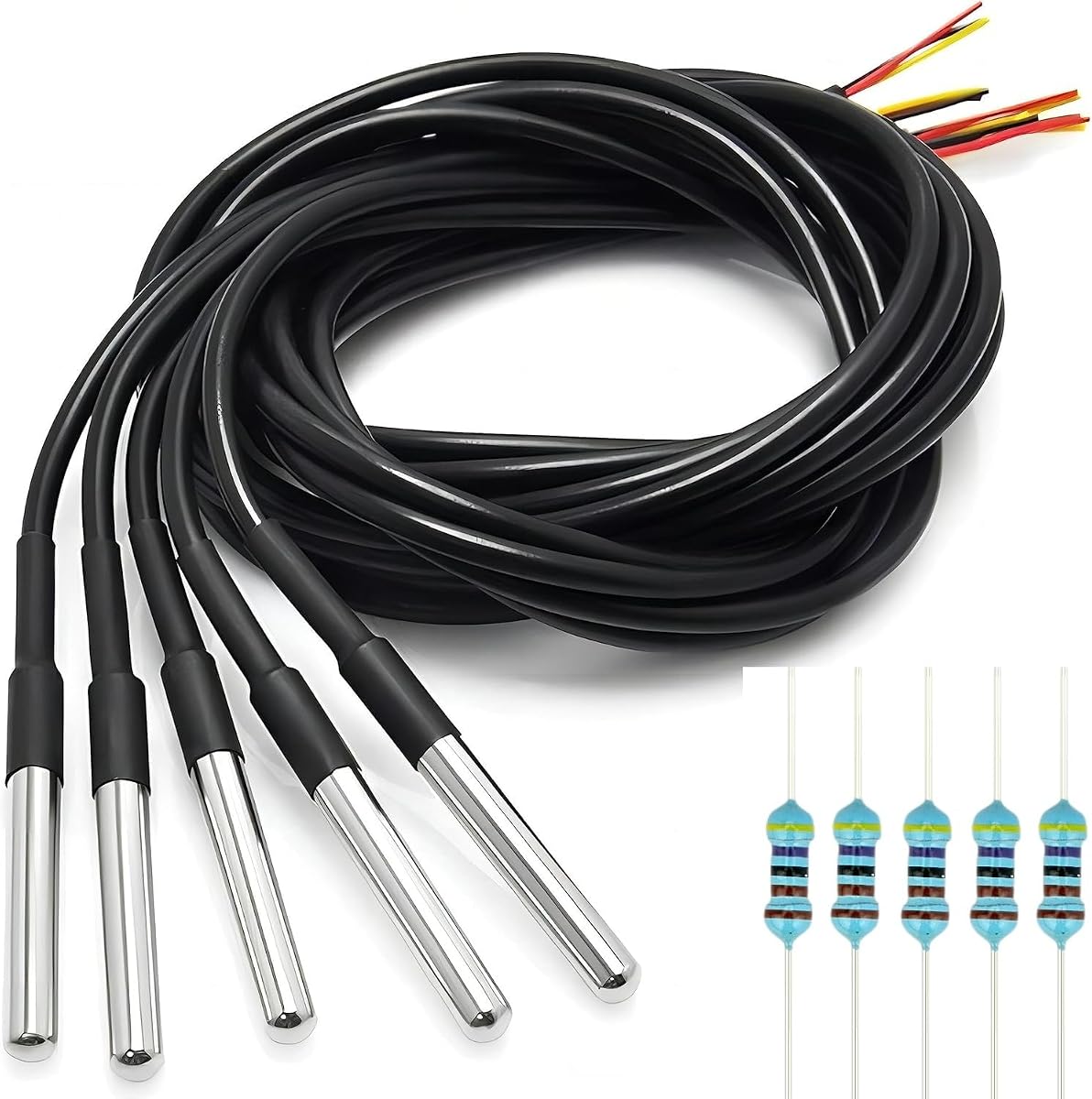
DS18B20 Waterproof Probe
4.4Editor score
Waterproof stainless steel case
Wide temperature measurement range
Simple 1-wire interface
This guide compares the top Arduino temperature sensor modules available in October 2026. We analyze accuracy, connectivity, and build quality to help you
Choosing the right Arduino temperature sensor is crucial for any electronics project involving climate control or monitoring. Whether you are building a greenhouse tracker or a home automation system, accuracy and reliability matter significantly.
We compared ten popular sensor modules based on their technical specifications, user feedback, and ease of integration. This list covers various communication protocols and environmental ratings to ensure you find a perfect match for your needs.
Each pick below highlights key features and potential trade-offs to help you decide quickly. Please note that product availability and pricing can change frequently, so check the current listings before making your final purchase decision.
4.4Editor score

5.0Editor score

4.7Editor score
The following table provides a side-by-side comparison of all ten selected temperature sensors. We highlight the main specifications and key features to help you identify the best fit for your specific application requirements.


This AHT30 module stands out as the top choice for projects demanding high precision temperature and humidity measurements. It features a perfect rating from users who appreciate its reliable digital output and stable performance in various environments.
We may earn a commission when you buy through this link, at no additional cost to you.
The key strength lies in its I2C communication which allows for easy integration with multiple devices on the same bus. The accuracy of plus or minus 0.3 degrees Celsius makes it superior to many entry level sensors in its class.
While the module is compact and efficient, it does rely on the I2C protocol which might require pull-up resistors on some boards. This is a minor trade-off given the significant improvements in data stability and speed.
Anyone building a weather station or a smart home system should consider this module. Its combination of accuracy and ease of use makes it the most versatile option for serious hobbyists and professionals alike.
The digital sensor ensures that every reading is consistent and reliable without drift over time.
Support for a wide voltage range allows connection to both 3.3V and 5V microcontrollers easily.
We may earn a commission when you buy through this link, at no additional cost to you.
This DS18B20 probe kit offers an unbeatable price point for those needing durable temperature monitoring. It includes five probes and the necessary resistors to get started immediately without extra trips to a store.
We may earn a commission when you buy through this link, at no additional cost to you.
The waterproof stainless steel casing allows you to measure temperatures in wet or harsh environments where plastic sensors would fail. This robustness makes it ideal for aquariums, greenhouses, and industrial monitoring.
The only downside is the slightly slower read speed compared to I2C sensors which is typical for 1-wire devices. However for for most hobbyist applications this latency is negligible and does not impact functionality.
If you need multiple sensors or a budget-friendly solution for large scale projects this kit is the clear winner. The included resistors save time and ensure a smooth setup process for beginners.
The package includes everything needed to connect the sensors to your microcontroller right out of the box.
Stainless steel protection ensures the sensor survives underwater or high humidity conditions without damage.
We may earn a commission when you buy through this link, at no additional cost to you.
The SHT31-D is a top-tier sensor known for its exceptional accuracy and stability in demanding environments. It is designed for industrial applications but is fully compatible with standard Arduino boards for high-end hobby projects.
We may earn a commission when you buy through this link, at no additional cost to you.
Its main benefit is the precision of the readings which remain stable over long periods without significant drift. The wide voltage range ensures it can work with 3.3V logic systems as well as standard 5V setups.
The premium price is justified by the quality and reliability which are critical for professional or critical monitoring tasks. While it costs more than basic modules the data integrity it provides is unmatched in this category.
For projects where data quality is paramount such as medical equipment or scientific experiments this module is the best choice. It offers peace of mind through its robust construction and superior calibration.
Built to withstand harsh conditions and provide reliable data for professional and critical applications.
Operates efficiently across a broad voltage range making it versatile for various power sources.
We may earn a commission when you buy through this link, at no additional cost to you.
The DHT11 remains a staple for beginners due to its simplicity and low cost. This pack provides five units which is great for learning multiple nodes or for projects where exact precision is not critical.
We may earn a commission when you buy through this link, at no additional cost to you.
It uses a single wire interface which simplifies the wiring process significantly. The built-in resistor and capacitor ensure stable operation without external components which is helpful for those new to electronics.
However the accuracy is limited compared to newer sensors and the update rate is slower. This means it is not suitable for fast changing environments but works well for general room monitoring.
This module is perfect for school projects or introductory tutorials where understanding the basics is the goal. The availability of tutorials and libraries makes it one of the easiest sensors to start with.
Extensive documentation and community examples make it easy to find code and solve problems.
Onboard circuitry reduces the need for extra parts on the breadboard.
We may earn a commission when you buy through this link, at no additional cost to you.
This kit is ideal when you need to place the sensor far from the microcontroller. The one meter cable allows for placement in tanks or deep containers without risking water damage to the electronics.
We may earn a commission when you buy through this link, at no additional cost to you.
The adapter module simplifies wiring by providing clear VCC DATA and GND connections. This reduces the risk of wiring errors and makes the physical setup cleaner and more organized.
The waterproof casing ensures reliability in wet environments which is essential for pool monitoring or fish tank projects. While the price is higher than bare probes the convenience and durability justify the cost.
Choose this option if your project requires physical separation between the reading device and the measurement point. The robust build quality ensures it will withstand continuous submersion effectively.
The one meter cable allows for sensor placement in hard to reach or distant locations.
The adapter board provides a clean interface for microcontrollers without complex soldering.
We may earn a commission when you buy through this link, at no additional cost to you.
This two-pack of DHT11 modules offers a very low entry cost for those testing multiple ideas. The pre-soldered wires save time on assembly allowing you to focus on programming and logic.
We may earn a commission when you buy through this link, at no additional cost to you.
The digital output simplifies the data processing on the microcontroller side. This makes it an excellent choice for Raspberry Pi users who want a plug-and-play experience without complex driver setups.
The limitations in accuracy and range are acceptable for general indoor monitoring tasks. If you need to measure extreme temperatures or humidity levels this module might not be the best fit.
For quick prototyping or classroom demos this pack provides sufficient functionality without breaking the budget. It is a reliable way to start experimenting with environmental sensing.
Pre-attached wires mean you can plug the module directly into the breadboard.
Ideal for buying multiple units for group projects or large scale testing.
We may earn a commission when you buy through this link, at no additional cost to you.
This kit stands out for its completeness offering probes boards wires and resistors in one package. The high user rating reflects satisfaction with the build quality and the ease of setup.
We may earn a commission when you buy through this link, at no additional cost to you.
The stainless steel probes are designed for continuous submersion and harsh conditions. This durability makes them a reliable choice for industrial or outdoor monitoring tasks where longevity is key.
The inclusion of jumper wires and resistors eliminates the need to source separate components which speeds up the project timeline. Color coded wires also prevent connection errors during assembly.
If you want a hassle-free experience with everything included this bundle is a top contender. It is particularly useful for those who prefer not to buy small components individually.
All necessary accessories are provided to get started immediately without extra purchases.
The stainless steel construction ensures the sensors last longer in tough environments.
We may earn a commission when you buy through this link, at no additional cost to you.
For large projects requiring multiple sensors this five-pack offers excellent value. The one meter cables allow for flexible placement throughout a system or building without splicing.
We may earn a commission when you buy through this link, at no additional cost to you.
The waterproof design ensures these probes can be used in wet or moist environments safely. This makes them suitable for monitoring multiple zones in a garden or greenhouse setup.
You will need to add an external pull-up resistor which is a small step for extra reliability. The trade-off is worth it for the cost savings when buying in bulk.
This is the best option for those setting up a network of temperature points across a large area. The consistent build quality across the five units ensures uniform performance.
Multiple probes allow you to build complex multi-node temperature monitoring networks.
One meter cables give you the freedom to place sensors far from the controller.
We may earn a commission when you buy through this link, at no additional cost to you.
This DHT22 module is an upgrade from the DHT11 with significantly improved accuracy and range. It supports negative temperatures which makes it more versatile for outdoor applications.
We may earn a commission when you buy through this link, at no additional cost to you.
The digital output ensures reliable communication with your microcontroller. The bidirectional data line is easy to manage with simple code libraries available for most platforms.
It is slightly more expensive than the DHT11 but the improved data quality is worth it for critical projects. The wider temperature range allows it to handle conditions the DHT11 cannot.
If you need more reliable humidity readings than the DHT11 offers this is a great next step. It strikes a good balance between cost and performance for hobbyist projects.
The AM2302 chip provides more precise readings for both temperature and humidity.
Support for negative temperatures makes it suitable for outdoor and freezer monitoring.
We may earn a commission when you buy through this link, at no additional cost to you.
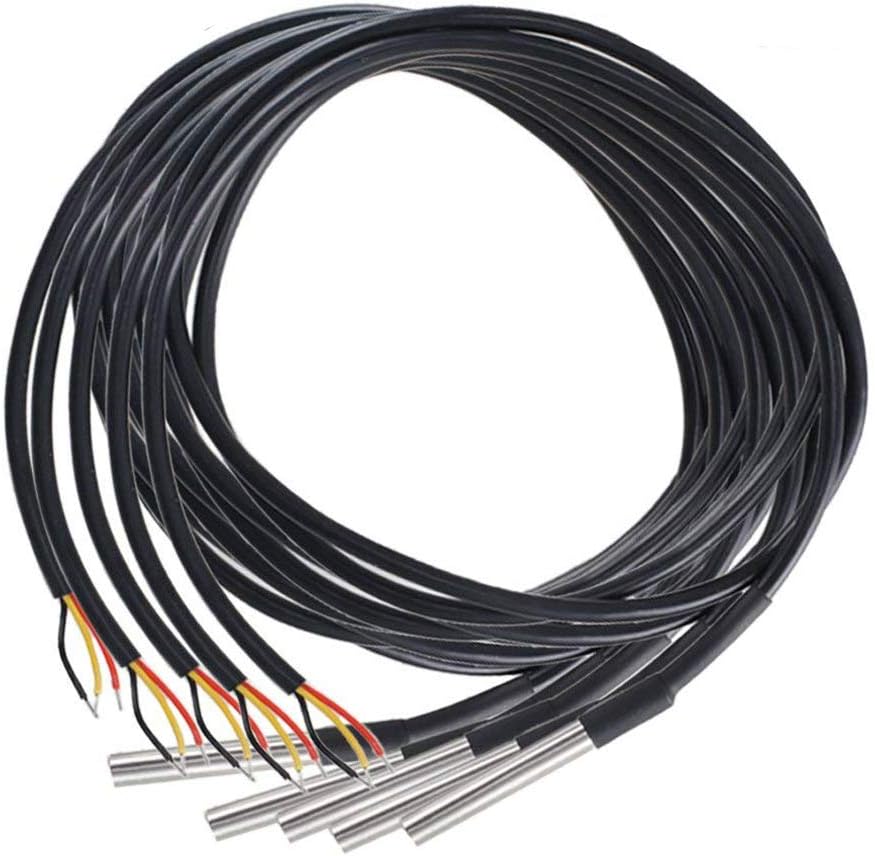
This five-pack provides reliable stainless steel probes suitable for a variety of environments. The consistent quality ensures that each probe performs similarly in your network setup.
We may earn a commission when you buy through this link, at no additional cost to you.
The one meter length allows for easy routing in tight spaces or over distances. This is particularly useful for monitoring multiple tanks or zones without extra extension wires.
You will need to add an external resistor for the data line but this is standard for these sensors. The build quality justifies the cost as they are durable and long lasting.
Choose this pack if you need multiple reliable sensors and are comfortable with basic wiring. It is a solid choice for industrial or agricultural projects requiring robust monitoring.
Stainless steel casing ensures long life and protection against physical damage.
Buying in bulk saves money compared to purchasing individual probes.
We may earn a commission when you buy through this link, at no additional cost to you.
Selecting the right sensor depends on your specific project requirements and environment. We outline the key factors to consider to ensure you make the best decision.
Accuracy refers to how close a reading is to the true value while precision refers to consistency. For general indoor monitoring a basic accuracy is acceptable but scientific or medical projects need high precision.
Prioritize sensors with tighter tolerance ratings if your project requires reliable data over time.
Sensors use protocols like 1-wire or I2C which affect wiring complexity and speed. I2C is faster and supports multiple devices but requires two signal wires plus power and ground.
Choose I2C for complex systems and 1-wire for simple setups where wiring simplicity is key.
Check the minimum and maximum temperature limits to ensure they cover your expected environment. Some sensors only work in room temperature ranges while others handle extreme cold or heat.
Always choose a range that extends beyond your expected operating temperatures to avoid damage.
If your sensor will be exposed to moisture it must have a waterproof housing or probe. Stainless steel probes are best for continuous submersion while plastic modules are for dry environments.
Ensure the casing matches your environment to prevent corrosion or electrical shorts.
Battery powered projects need low power sensors to maximize battery life. Some modules have sleep modes or lower draw which is crucial for portable or remote installations.
Check the power specs carefully if your device is not continuously connected to mains power.
The price often reflects quality but sometimes you pay for extras like cables or resistors. Kits with accessories might save time even if the unit price is higher than bare components.
Balance your budget with the features you actually need to avoid overspending on unnecessary specs.
Beginners should look for modules with pre-soldered headers or adapter boards. This reduces the need for soldering and makes breadboarding much simpler.
Choose a sensor with clear documentation and library support to speed up your development process.
Ensure the sensor voltage matches your microcontroller. Some sensors require 3.3V logic while others work with 5V which can cause issues if not matched correctly.
Verify the logic level requirements to ensure stable data communication without voltage converters.
Start by connecting the VCC and GND pins to your power supply and the signal pin to a digital input on your microcontroller. Ensure the voltage levels match to avoid damaging the sensor or board.
Install the necessary library in your IDE to read data from the sensor. Most popular sensors have community maintained libraries that simplify the code to just a few lines.
Protect the sensor from physical damage and ensure connections are tight to prevent signal loss. Periodically check the readings for consistency and recalibrate if you notice drift over time.
Yes you can connect multiple sensors using protocols like I2C or 1-wire. For 1-wire you can daisy chain devices by using a unique address for each. For I2C you can use unique addresses or expanders to manage several units easily.
Yes most 1-wire sensors like the DS18B20 require a pull-up resistor on the data line. A 4.7K resistor is standard and connects between the data wire and the power line to ensure stable signals.
Calibration involves comparing your sensor readings against a known accurate thermometer. Adjust your code to apply a fixed offset based on the difference to improve accuracy without hardware changes.
Waterproof 1-wire probes like the DS18B20 are ideal for water temperature. They are designed for submersion and come in stainless steel cases that resist corrosion and pressure changes.
Yes most Arduino compatible sensors work with Raspberry Pi via GPIO pins. You may need to enable I2C or adjust voltage levels depending on the specific sensor and Pi model.
Fluctuations often come from loose connections or lack of a pull-up resistor. Ensure all wires are secure and check your code for proper averaging to smooth out noisy data.
We have reviewed the top ten temperature sensors available for Arduino in October 2026. From the precise AHT30 to the budget-friendly DS18B20 there is a perfect option for every need.
Prioritize accuracy and environmental durability based on where you plan to use your project. If you need indoor monitoring a simple module will suffice but outdoor or wet environments require robust waterproof probes.
Remember that prices and availability can change so verify the current listings before you buy. We hope this guide helps you find the right component for your next exciting electronics project.