
SVBONY SV503
4.8Editor score
102mm F7 ED Glass
Dual-Speed Focuser
Field Rotator Included
This guide compares the top apochromatic refractors for 2026, analyzing optics, portability, and value to help you choose the best telescope for your needs.
Apochromatic refractors represent the pinnacle of optical clarity for serious astronomers. They eliminate color fringing to deliver crisp views of planets and deep sky objects alike.
We evaluated ten leading models based on glass quality, focal ratios, and build features. Our comparison highlights which scopes offer the best performance for visual use or astrophotography.
Each pick below includes detailed specs and real-world advantages. Note that prices and availability change frequently, so verify current listings before making your final purchase decision today.
4.8Editor score

4.9Editor score

4.5Editor score
The following table provides a side-by-side look at the key specifications for each telescope. This helps you quickly compare aperture, focal ratios, and special features across the entire list.




The SVBONY SV550 AP0 stands out as a premier choice for those seeking high-end optics without breaking the bank. It features a triplet apochromatic design that virtually eliminates chromatic aberration.
We may earn a commission when you buy through this link, at no additional cost to you.
Its optical structure uses one piece of S-FPL51 low-dispersion ED glass alongside two correction glasses. This setup ensures bright, high-contrast images perfect for exploring galaxies and nebulae.
While the scope is lightweight, the air-spaced triple design requires careful handling to maintain alignment. Extinction measures inside the barrel help prevent internal reflections during long exposures.
This scope is ideal for visual observers and astrophotographers who need a reliable, sharp optic. Its dual-speed focus mount makes precise adjustments easy for any camera setup.
The triplet structure effectively removes blue-edge aberration common in simpler refractors for clearer image edges.
The magnesium alloy dual-speed focuser reduces weight while allowing fine adjustments critical for imaging.
We may earn a commission when you buy through this link, at no additional cost to you.
The Explore Scientific ED80 Essential Series delivers brilliant views thanks to its genuine FCD1 HOYA extra-low dispersion optical glass. This glass quality is central to its reputation for color accuracy.
We may earn a commission when you buy through this link, at no additional cost to you.
Proprietary enhanced multi-layer coatings on all surfaces maximize light transmission. This results in stunning details whether you are looking at the Moon or deep-sky objects.
The telescope is designed with portability in mind, featuring a retractable dew shield. This makes it perfect for spontaneous stargazing sessions or guiding duties on larger setups.
For those who value sharp stars, the front cell offers push-pull adjustments for precision collimation. It is a robust choice for users who want USA-based support.
Using FCD1 HOYA glass ensures minimal color fringing and sharp details across the entire field of view.
The push-pull adjustments allow you to fine-tune the optical train for the tightest possible star points.
We may earn a commission when you buy through this link, at no additional cost to you.
This bundle offers the SVBONY SV550 OTA paired with the SV209 Field Flattener, making it a complete package for astrophotography. The 1.0X flattener corrects field curvature effectively.
We may earn a commission when you buy through this link, at no additional cost to you.
The telescope adopts extreme extinction measures with multiple light barriers inside the barrel. This design choice helps meet the ultimate pursuit of extinction for cleaner backgrounds.
Constructed with magnesium alloy, the focusing seat reduces weight by over 20% compared to standard aluminum. This lighter weight makes carrying and mounting much easier for users.
The package includes necessary adapters to ensure standard 55mm back focal length. It supports both half-frame and full-frame cameras, offering great versatility for your imaging rig.
The included SV209 ensures flat stars across the entire sensor, crucial for edge-to-edge sharpness.
Magnesium alloy components reduce load significantly without compromising the structural integrity of the scope.
We may earn a commission when you buy through this link, at no additional cost to you.
The SVBONY SV550 APO refractor offers a large 122mm aperture that gathers significant light for clearer images. It is a great travel telescope for serious astrophotography needs.
We may earn a commission when you buy through this link, at no additional cost to you.
The 122mm aperture utilizes a FPL-51 triplet apochromatic lens structure. This contains one piece of ED glass to provide better correction of aberration than doublets.
Portability is enhanced by a comfortable carrying handle integrated into the SV211 dovetail base. This allows for easy movement of the large-aperture telescope without extra effort.
Installation is simple with the included finder scope mount bracket. The screws and wrench provided allow you to set up the guide scope quickly for precise tracking.
The large aperture allows you to see fainter deep-sky objects with better clarity and higher limiting magnitude.
The convenient carrying handle makes moving the heavy tube safe and easy during setup sessions.
We may earn a commission when you buy through this link, at no additional cost to you.
The Askar 71F takes practicality into full consideration with effective weight control. The OTA weighs only 2.5kg, making it incredibly easy to carry and use anywhere.
We may earn a commission when you buy through this link, at no additional cost to you.
The entire lens barrel uses high-quality CNC processing technology for a premium finish. The interior is painted with high-quality matte paint to effectively reduce stray light reflection.
This scope is convenient for photographic composition and visual observation alike. You can simply loosen screws to rotate the focus 360 degrees for perfect alignment.
As an affordable self-flattened OTA, it offers versatility for birding and scenery. It is an excellent entry point for those wanting high-quality optics without bulk.
The matte interior paint reduces unwanted reflections, ensuring cleaner contrast in your visual and imaging work.
The 360-degree rotation capability allows for camera alignment without needing to twist the entire telescope tube.
We may earn a commission when you buy through this link, at no additional cost to you.
This telescope features a 102mm aperture and FMC coating to improve light transmission. It delivers brighter, higher-contrast images for both astrophotography and visual observation.
We may earn a commission when you buy through this link, at no additional cost to you.
Reduced chromatic aberration is achieved with S-FPL51 ED glass. This minimizes color fringing significantly, allowing for true-to-life color and sharp detail.
The built-in 360-degree field rotator allows perfect camera alignment without rotating the tube. Coupled with the smooth dual-speed focuser, achieving critical focus is effortless.
It offers 90mm of focus travel, enabling precise focusing with accessories. The retractable hood blocks stray light and protects the objective lens from dew.
The 102mm diameter provides substantial light gathering for viewing faint objects with clarity.
The dual-speed focuser allows you to make tiny adjustments for sharp stars even with heavy cameras.
We may earn a commission when you buy through this link, at no additional cost to you.
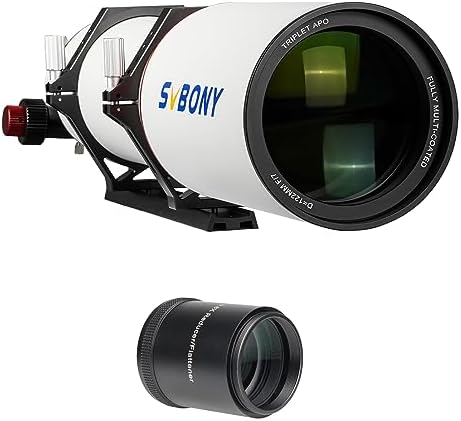
This bundle combines the SV550 APO refractor with a 0.8X focal reducer and field flattener. It is designed specifically for prime focus astrophotography with the SV550.
We may earn a commission when you buy through this link, at no additional cost to you.
The 122mm aperture gathers more light for clearer images suitable for deep sky photography. It can even capture fainter deep-sky objects due to the higher limiting magnitude.
The SV209 field flattener corrects the defect of field curvature of the shooting target. This improves imaging quality and shooting efficiency at the edge of the field of view.
It is a great travel telescope for observation. The optics provide better correction of aberration and greatly reduce chromatic aberration for enhanced sharpness.
The 0.8X reducer increases the field of view and shortens exposure times significantly for deep sky targets.
The flattener ensures stars remain round and sharp across the entire image sensor without distortion.
We may earn a commission when you buy through this link, at no additional cost to you.
The SV550 APO refractor is a compact scope with a 122mm aperture and 854mm focal length. It is ideal for astrophotography and observation without excessive weight.
We may earn a commission when you buy through this link, at no additional cost to you.
The aperture utilizes a FPL-51 triplet apochromatic lens structure. This provides better correction of aberration and enhances clarity for detailed astrophotography sessions.
A portable handle and dovetail base allow for convenient carrying and moving of the tube. This makes transport easier for a large-aperture telescope of this size.
The included SV209 field flattener corrects the curvature defect of the target. This ensures high-quality imaging across the entire field of view for better results.
The triplet lens structure ensures high sharpness and minimal color errors across the visual and imaging field.
The handle and dovetail base make moving and setting up the telescope straightforward for users.
We may earn a commission when you buy through this link, at no additional cost to you.
Use this APO OTA to reveal the wonders of celestial bodies like the Messier catalog. The difficulty factor is simple for targets like M42 and M45.
We may earn a commission when you buy through this link, at no additional cost to you.
The triplet apochromatic optics structure effectively improves the blue-edge chromatic aberration problem. This ensures sharp, bright, and clear images without color fringing.
SV209 is a special field flattener designed for the SV550 80F6 OTA. It effectively improves the image quality problem regarding fringe field curvature during imaging.
The optics use ultra-wide band fully multilayer coated lenses to prevent reflections. A comfortable carrying handle makes moving the OTA safe during installation and setup.
This scope is optimized for revealing the details of common deep-sky objects like nebulae and clusters easily.
Multilayer coatings prevent irritating reflections and ensure maximum light transmission for crisp viewing.
We may earn a commission when you buy through this link, at no additional cost to you.
This kit includes the SV550 APO refractor paired with a mini guide scope and camera. It is designed to be a compact travel telescope for astrophotography.
We may earn a commission when you buy through this link, at no additional cost to you.
The SV905C camera is compact and highly sensitive with 1.23-megapixel resolution. It has a high peak QE of 80% and low read noise for tight tracking.
The telescope camera supports mainstream auto guiding cameras with compatible mounts. It allows you to achieve tight tracking of faint guide stars for long exposures.
The 122mm aperture provides clear and detailed images suitable for deep-sky photography. The bundle offers a complete setup for enthusiasts ready to start imaging immediately.
The included camera allows for precise tracking correction, essential for capturing sharp stars in long exposures.
This bundle provides the essential optical and electronic tools needed to begin astrophotography without extra purchases.
We may earn a commission when you buy through this link, at no additional cost to you.
Selecting the right apochromatic refractor requires balancing several factors. This section helps you identify what matters most for your specific goals.
Aperture determines how much light a telescope gathers. A larger aperture like 122mm allows you to see fainter deep-sky objects with greater detail than an 80mm model.
Prioritize larger aperture if you plan on deep-sky photography. Smaller apertures are better for portability and planetary viewing.
Apochromatic refractors use triplet or quadruplet lenses to eliminate color fringing. Look for designs that use extra-low dispersion (ED) glass like FPL-51.
Air-spaced triplet designs are preferred over cemented ones for better correction of chromatic aberration in high-resolution imaging.
The focal ratio affects exposure times and field of view. Faster ratios like f/6 are better for capturing large nebulae quickly.
Slower ratios like f/7 offer higher magnification for planets and galaxies. Choose based on your target preferences.
Build quality impacts the longevity and performance of your scope. Look for robust tubes and precision focusers that hold focus without drifting.
Opt for models with aluminum or magnesium construction to ensure durability while managing overall weight effectively.
A high-quality focuser is critical for sharp astrophotography. Dual-speed focusers allow for fine adjustments essential for tight focus points.
Ensure the focuser can handle the weight of your camera and accessories without flexing during exposure.
Many bundles include essential items like field flatteners or guide scopes. These save money and ensure compatibility with your imaging setup.
Check if a flattener is included if you plan on photography. Without it, edge stars may appear blurry or distorted.
Portability matters if you travel to dark sites. Lightweight models under 5kg are easier to transport and set up quickly.
Consider the weight of the OTA and any required mounts. Portable handle features can significantly ease the transport process.
Reliable support ensures you can resolve issues quickly. Brands based in regions like the USA often offer better customer service.
Verify warranty terms before buying. Good support provides peace of mind for high-value optical purchases.
Allow your telescope to acclimate to outdoor temperatures for 30 minutes. This prevents thermal currents inside the tube from blurring your view.
Always store the scope in a dry place. Use caps on the dew shield and focuser to keep out dust and moisture that can harm coatings.
Clean lenses only when necessary using a soft air blower. Avoid touching glass surfaces directly to prevent scratches or oils from damaging the coating.
An Apochromatic (APO) refractor uses special low-dispersion glass and triplet optics to eliminate color fringing. A standard refractor often shows blue halos around bright objects. APOs provide much sharper and cleaner images.
No, a field flattener is mainly for astrophotography. Visual observers do not need one because eyepieces have a smaller field of view where curvature is less noticeable. It is an unnecessary expense for visual use only.
Yes, APO refractors are excellent for planetary imaging due to their high contrast and sharp optics. They provide steady views of moons and planets. Ensure you use a high-quality camera for best results.
Most quality APOs arrive pre-collimated. If adjustments are needed, use the push-pull screws on the front cell to center the optical elements. Adjust slowly while checking star tests to ensure the collimation is correct.
A sturdy motorized mount like a GEM is recommended for astrophotography. Visual use may only need a sturdy alt-azimuth mount. Ensure the mount supports the weight of your tube plus accessories.
Yes, many APO refractors are versatile for terrestrial viewing. However, ensure the setup includes a diagonal that corrects image inversion. This makes spotting and identifying targets easier during the day.
Prices vary widely based on aperture and glass quality. Budget models start around 600 dollars while premium ones can exceed 1500 dollars. Check current listings to find the best deal for your needs.
This is usually caused by field curvature. Using a field flattener corrects this issue. Without one, the edges of your image or view may appear soft compared to the center.
We have reviewed ten top-rated apochromatic refractors to help you find the perfect match. Each option offers unique benefits for specific observing or imaging needs.
Prioritize aperture and optical glass quality when making your choice. These factors have the greatest impact on your overall viewing experience and results.
Remember to check current prices and stock availability before buying. Technology and deals change frequently, so act quickly when you find the right model.