
EinScan Rigil
4.7Editor score
Wireless All-in-One
Hybrid Light Source
Onboard Computing
This guide compares ten top 3D scanners for reverse engineering, covering precision, speed, and features to help you find the perfect tool for your projects.
Reverse engineering requires precise tools to capture complex geometries accurately. A high-quality 3D scanner ensures that every detail is recorded without errors.
We evaluated ten leading scanners based on accuracy, speed, and ease of use. Our team analyzed technical specifications and user feedback to create this list.
Each pick highlights key strengths for different needs. Prices fluctuate regularly, so check current listings before making your final purchasing decision today.
4.7Editor score

4.8Editor score

4.6Editor score
This table provides a side-by-side comparison of all ten selected scanners, highlighting their core specifications and unique capabilities for reverse engineering tasks.



The Revopoint MetroX Pro stands out as a top choice for professional reverse engineering. It offers industrial-grade precision with blue laser technology that captures intricate details flawlessly.
We may earn a commission when you buy through this link, at no additional cost to you.
Its advanced scanning modes allow users to handle various surface types including shiny or dark materials without spraying. The real-time streaming feature enhances workflow efficiency by allowing monitoring on mobile devices.
While the software suite is intuitive, users should note that Revo Design and Revo Measure are sold separately and only support Windows. This might require additional investment for some users.
Engineers and designers seeking accurate data for CAD workflows will find this scanner invaluable. Its balance of speed and precision makes it a reliable tool for industrial applications.
The blue laser ensures high accuracy on complex geometries, reducing errors during data capture for engineering tasks.
With multiple modes like cross-line and parallel lines, users can adapt to different object sizes and surface conditions easily.
We may earn a commission when you buy through this link, at no additional cost to you.
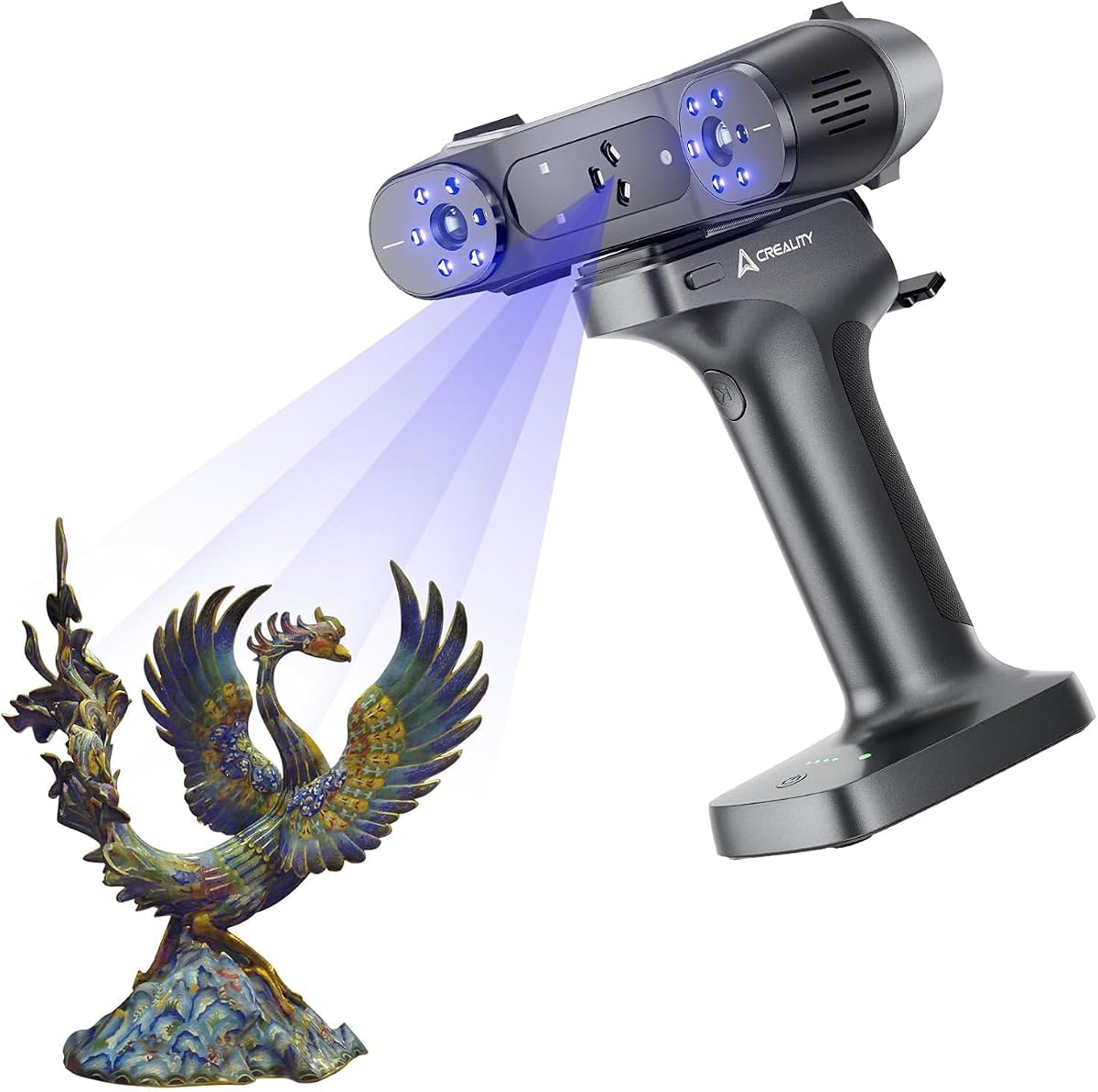
The EinScan Rigil is a premium option designed for professionals who need ultimate flexibility. It combines wireless operation with advanced hybrid light source technology for precise scans.
We may earn a commission when you buy through this link, at no additional cost to you.
Its onboard computing power allows for fast processing without relying on a connected PC. The hybrid laser system handles dark and reflective surfaces effortlessly, making it ideal for automotive parts.
The higher price tag reflects its advanced capabilities. Users should be prepared for a slight learning curve to maximize its potential in complex reverse engineering projects.
For those prioritizing portability and speed, the Rigil delivers exceptional results. It is perfect for fieldwork where cables and external power sources are not available.
Wi-Fi 6 and onboard computing enable true wireless scanning, removing cable constraints during detailed inspection tasks.
The combination of blue laser and IR VCSEL ensures high fidelity even on challenging surfaces like polished metal.
We may earn a commission when you buy through this link, at no additional cost to you.
The Creality Otter Lite provides an accessible entry point for reverse engineering tasks. It balances affordability with sufficient precision for many hobbyist and light industrial applications.
We may earn a commission when you buy through this link, at no additional cost to you.
Its lightweight design makes it easy to carry around. The dual-mode scanning capability allows users to switch between close-range and long-range based on object size.
While it lacks the extreme precision of high-end models, it is excellent for prototyping and educational purposes. The included kit ensures you have everything needed to start immediately.
DIY enthusiasts and small workshops will find this scanner cost-effective. It is a strong choice for those needing reliable data without breaking the budget.
Weighing just 235g, it fits easily in a bag, allowing for on-site inspections without heavy equipment.
RGB cameras capture vibrant textures, useful for visual inspection and presentation of scanned models.
We may earn a commission when you buy through this link, at no additional cost to you.
The Revopoint MetroY Ultra focuses on speed without sacrificing accuracy. With up to 90 FPS, it accelerates data acquisition for large-scale industrial inspections.
We may earn a commission when you buy through this link, at no additional cost to you.
Its ability to scan outdoors in harsh sunlight makes it unique. The battery grip provides extra power for field work, ensuring uninterrupted operations during critical tasks.
While fast, achieving maximum frame rates requires a capable GPU. This may limit performance for users with older computer setups or lower-end hardware.
Manufacturing and automotive teams needing rapid turnaround will appreciate this tool. It effectively handles medium to large objects with precision.
Up to 90 FPS enables quick captures of large parts, reducing overall project time significantly.
Robust laser modes allow scanning even in direct sunlight, expanding usable environments beyond labs.
We may earn a commission when you buy through this link, at no additional cost to you.
The Raptor Pro offers impressive range, from tiny parts to entire car bodies. It uses multiple laser lines to ensure coverage across different sizes efficiently.
We may earn a commission when you buy through this link, at no additional cost to you.
Its compatibility with Mac systems expands its reach to more design studios. Full-color 24-bit capture adds realism useful for visual documentation and analysis.
Operating it requires significant system resources. Users must ensure their computers meet recommended specs to avoid slowdowns during complex data processing tasks.
Automotive and industrial designers needing one solution for all sizes will value this versatility. It bridges the gap between desktop and large-scale scanning.
Handles items from 5mm to 4000mm, making it suitable for diverse engineering and inspection needs.
Works with both Windows and Mac, offering flexibility for teams using different operating systems.
We may earn a commission when you buy through this link, at no additional cost to you.
The INSPIRE 2 is designed for users who prioritize weight and simplicity. At just 190g, it is easy to handle for extended periods without fatigue.
We may earn a commission when you buy through this link, at no additional cost to you.
Optical zoom allows focusing on specific details, enhancing accuracy for small features. Outdoor filters enable reliable scanning in semi-bright conditions effectively.
It lacks color capture, focusing instead on geometric accuracy. This makes it best suited for applications where surface texture is less critical than shape.
Educational and prototyping labs benefit from its ease of use. It provides a reliable balance of performance and portability for standard tasks.
Adjustable zoom helps capture mixed-geometry surfaces with higher fidelity in tight areas.
Aerospace-grade aluminum ensures durability while keeping the weight minimal for handheld use.
We may earn a commission when you buy through this link, at no additional cost to you.
This standard version of the MetroX Pro shares core features with the advanced model. It delivers solid industrial-grade accuracy for routine reverse engineering workflows.
We may earn a commission when you buy through this link, at no additional cost to you.
Tracking modes adapt to different surface complexities, ensuring stability during scanning. The auto turntable feature simplifies capturing symmetric objects with one click.
Users should consider that Revo Measure and Revo Design are sold separately. This adds to the total cost if full CAD integration is needed for projects.
It is an excellent middle-ground choice for small businesses. It offers professional reliability without the complexity of high-end models.
Feature and marker tracking modes provide adaptability for both simple and complex object geometries.
Automated scans reduce manual effort and ensure consistent rotation angles during data capture.
We may earn a commission when you buy through this link, at no additional cost to you.
The Raptor Pro delivers metrology-grade accuracy suitable for precision inspection. It handles various sizes without compromising on detail or stability.
We may earn a commission when you buy through this link, at no additional cost to you.
Wireless outdoor readiness allows scanning in real-world environments. The face and body modes make it versatile for medical and animation applications as well.
Maintaining stability requires attention to system configurations. Users must adhere to recommendations for GPU and RAM to ensure consistent performance.
It suits users needing robust results across different scales. It remains a strong contender for comprehensive reverse engineering work.
Unique modes enable human body scans in under two minutes, useful for custom fit applications.
Wireless connection and high lux tolerance enable scanning directly on shop floors or outside.
We may earn a commission when you buy through this link, at no additional cost to you.
The Raptor X combines high accuracy with wireless convenience. It captures full color and geometric data quickly, supporting large industrial components efficiently.
We may earn a commission when you buy through this link, at no additional cost to you.
Fast charging ensures minimal downtime. The battery allows for long scanning sessions without needing to be tethered to a power source constantly.
The higher cost reflects its advanced wireless capabilities. Users must balance this investment against their specific need for mobile scanning speed.
It is ideal for engineers needing precision on large parts. It supports seamless workflow from capture to processing.
Wi-Fi 6 ensures low latency data transfer, keeping the scanning process fluid and responsive.
Charging to 80% in 1.5 hours keeps operations running smoothly without frequent breaks.
We may earn a commission when you buy through this link, at no additional cost to you.
The Raptor Pro offers high-resolution scanning for detailed engineering tasks. It supports Mac and Windows, ensuring broad compatibility for design teams.
We may earn a commission when you buy through this link, at no additional cost to you.
Dual laser modes provide flexibility for various material types. Software integration ensures seamless data transfer into CAD systems for precise modeling.
Maintaining high precision requires regular calibration. Users must commit to setup routines to keep accuracy levels consistent over time.
It is a powerful tool for automotive and artifact scanning. It balances quality with professional usability for complex projects.
Resolution settings from 0.05mm to 2mm allow users to adapt to different project needs easily.
Compatibility with Mac series processors ensures professional designers have flexible system options.
We may earn a commission when you buy through this link, at no additional cost to you.
Choosing the right 3D scanner involves evaluating accuracy, speed, and workflow needs for your specific reverse engineering applications.
Accuracy defines how close scanned data is to the real object. Look for at least 0.05mm for general engineering tasks and 0.01mm for tight tolerances.
Prioritize models with consistent metrology-grade performance to ensure reliable CAD conversions.
Faster frame rates reduce time spent capturing large objects. High-speed scanners improve workflow efficiency and data acquisition.
Select devices with high FPS to handle industrial parts without frequent interruptions.
Some materials like shiny or dark surfaces are hard to scan. Advanced laser or structured light technologies avoid the need for spray.
Choose models that handle diverse materials without extra prep work to save time.
Wireless capability allows scanning in different locations without cables. Portability ensures flexibility for fieldwork or large assemblies.
Opt for lightweight designs with battery support if you work outside the lab.
Software compatibility determines how well data moves to CAD tools. Check for support for platforms like SolidWorks or Geomagic.
Ensure the scanner supports file formats needed for your design pipeline.
Blue lasers offer better contrast for reflective materials. Structured light works well for smaller objects with fine details.
Match the source to your material types to ensure accurate texture capture.
Regular calibration maintains high precision over time. Automated systems reduce manual effort during this process.
Look for scanners with easy-to-use calibration tools for consistent results.
Cost varies widely from entry-level to professional industrial tools. Higher prices often mean better durability and software support.
Balance upfront costs with total value and software requirements for your projects.
Always calibrate your scanner before starting. Use the provided board and follow software prompts for best accuracy.
Keep surfaces clean to ensure better data capture. Avoid dust or dirt that may affect laser readings.
Store the device in a dry place after use. Protect it from shocks to maintain long-term precision and functionality.
Reverse engineering involves capturing physical object data to create digital CAD models. A 3D scanner records geometry for modification or replication.
Modern blue laser scanners handle shiny surfaces without spray. However, dark or reflective materials might still need markers for best results.
Most export common formats like STL, OBJ, and PLY. These are easily imported into CAD software for further work.
Yes, many models support outdoor scanning in various light conditions. Look for high lux tolerance for consistent performance.
Handheld models offer accuracy from 0.01mm to 0.05mm. This is usually sufficient for detailed reverse engineering tasks.
Software quality determines how well data converts to CAD. Ensure compatibility with your preferred design tools before buying.
Calibrate before critical projects or monthly for regular use. Regular checks ensure consistent high-quality results.
The Revopoint MetroX Pro, EinScan Rigil, and Creality Otter Lite offer top solutions across different needs.
Prioritize accuracy and software compatibility for your specific engineering tasks.
Always verify current prices and availability before finalizing your purchase.