
UNI-T UTG962E Handheld 60MHz 2Ch Arbitrary Waveform Generator
5.0Editor score
60 MHz max output frequency
Dual channel arbitrary waveforms
Includes USB connectivity options
Compact palm-sized design
Finding the right Amfm Signal Generator is crucial for engineers and hobbyists alike. These devices produce precise electrical signals for testing circuits and verifying functionality across various electronic applications effectively.
We evaluated ten leading models based on frequency range, modulation capabilities, and build quality. Our analysis focuses on real-world performance to ensure you select a generator that meets your specific testing requirements today.
Each pick highlights key strengths and potential limitations found in user feedback. Please note that pricing and availability change frequently, so verify current details before making your final purchase decision online.
5.0Editor score

4.2Editor score

4.4Editor score
As an Amazon Associate we earn from qualifying purchases.
This side-by-side comparison outlines the core specifications of every model considered in our guide. It helps you quickly identify which device offers the best balance of features and value for your specific project needs.




The UNI-T UTG962E stands out as the top performer in our review. With a perfect 5.0 rating, it delivers exceptional precision and versatility for both fieldwork and lab testing.
We may earn a commission when you buy through this link, at no additional cost to you.
Its standout quality is the dual-channel arbitrary waveform capability. You can generate complex signals simultaneously on two channels, which is vital for testing differential circuits or comparing phase relationships accurately.
The device supports AM, FM, and PM modulation natively. This makes it a true Amfm Signal Generator suited for radio frequency experiments and communication system debugging without needing extra adapters or modules.
While the price is higher than entry-level tools, the performance justifies the investment for professionals. It is an ideal choice for engineers needing reliable, high-speed signal generation in a portable form factor.
The 60 MHz frequency range and low noise output ensure clean signals for sensitive radio frequency testing tasks effectively.
Its compact size and included adapter mean you can take professional grade testing capabilities anywhere without heavy bulky equipment.
We may earn a commission when you buy through this link, at no additional cost to you.
The OWON DGE2035 offers a robust set of features for academic and industrial labs. Its strong 4.2 rating reflects consistent reliability and high-quality waveform generation for educational purposes.
We may earn a commission when you buy through this link, at no additional cost to you.
The 125MSa/s sampling rate ensures that generated signals are smooth and accurate. This high speed is critical when testing circuits that respond to rapid changes in voltage or frequency.
PC control support adds significant value for automated testing environments. You can script complex signal sequences and run them remotely, saving time and reducing human error during long experiments.
This unit is a fantastic choice for universities and research facilities. It balances cost and performance well, providing professional capabilities that are accessible to students and engineers alike.
The large color screen makes it easy to verify waveform shapes and settings at a glance without squinting at small text.
USB connectivity allows for remote operation, making this device perfect for integrating into larger automated test systems easily.
We may earn a commission when you buy through this link, at no additional cost to you.
This 6-Band Signal Generator excels in maintaining signal purity during radio testing. Its focus on low phase noise makes it a specialized tool for communication hardware verification.
We may earn a commission when you buy through this link, at no additional cost to you.
The device covers a broad spectrum from 100KHz up to 150MHz. This wide range allows you to test various radio frequencies without needing to switch between multiple devices for different bands.
Users appreciate the sturdy metal build which protects the internal components. It is designed to withstand the rigors of daily use in busy workshops or maintenance departments.
Ideal for technicians maintaining electronic equipment, this unit provides reliable RF signals. It may lack arbitrary waveform capabilities but delivers excellent performance for standard sine wave AM FM tests.
The low phase noise ensures that your radio tests are not skewed by signal jitter or unwanted interference during critical measurements.
Constructed with high-class metal and plastic, this generator is built to resist scratches and impacts in demanding industrial environments.
We may earn a commission when you buy through this link, at no additional cost to you.
The Upgraded RF Signal Generator covers a massive frequency range reaching up to 4400MHz. This capability makes it one of the few affordable options for high-frequency microwave signal testing.
We may earn a commission when you buy through this link, at no additional cost to you.
Although it primarily outputs sine waves, the sweep mode allows you to scan across frequencies efficiently. This is useful for checking antenna responses or frequency selective components.
Power off memory is a convenient feature for field technicians. You can turn the unit off and on again without having to reset all your frequency and amplitude settings manually each time.
This tool is best suited for basic RF troubleshooting rather than complex signal generation. If you need to reach microwave bands on a budget, this model offers unmatched range for the price.
Reaching 4400MHz allows testing of modern wireless modules and RF front ends that operate well above standard radio frequencies.
Compatible with mobile chargers and power banks, this generator can operate wherever you have portable electricity, not just near a wall outlet.
We may earn a commission when you buy through this link, at no additional cost to you.
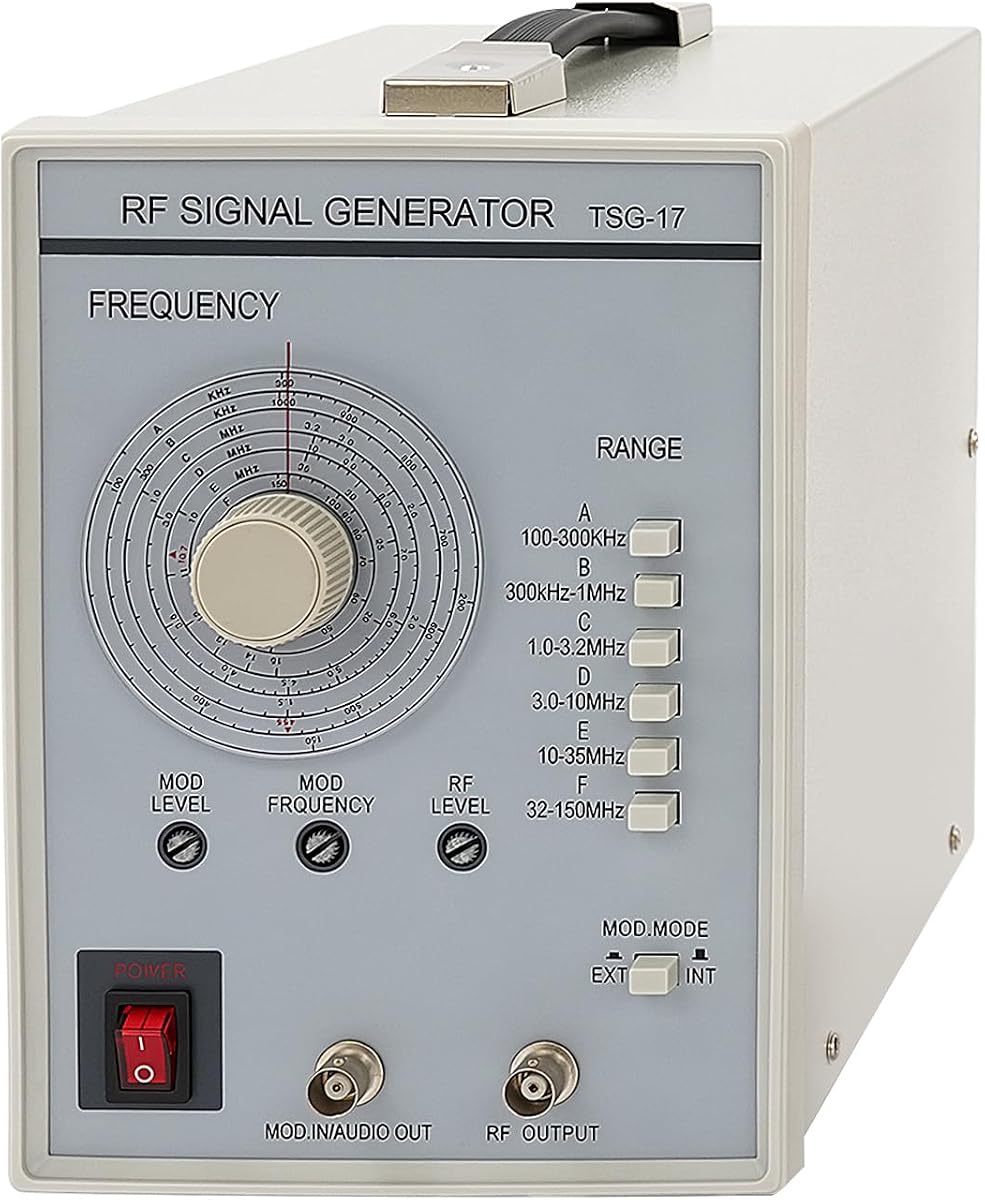
The TSG-17 is designed for straightforward RF and AM radio frequency testing. It provides a reliable sine wave output with amplitude modulation for checking receiver sensitivity.
We may earn a commission when you buy through this link, at no additional cost to you.
Its output range from 1mV to 100mV allows for precise control of signal strength. This is useful when you need to simulate weak signals to test how a device performs under stress.
The unit supports external modulation signals from 50Hz to 20KHz. This flexibility lets you introduce specific modulation patterns to verify the integrity of audio or data paths.
While it may not have the advanced features of high-end units, it serves well for commercial and household maintenance. It is a functional tool for basic radio repairs and component verification.
The wide output voltage range helps in calibrating receivers to ensure they respond correctly to varying signal intensities.
Designed for commercial use, this generator maintains steady output levels over time, which is important for consistent test results.
We may earn a commission when you buy through this link, at no additional cost to you.
This generator is tailored for industrial process control rather than RF testing. It excels at producing 4-20mA and 0-12V signals that are standard in automation systems.
We may earn a commission when you buy through this link, at no additional cost to you.
The 1500mAh battery ensures you can work on the plant floor without carrying a heavy power adapter. It is ideal for technicians verifying sensors and controllers in the field.
PWM output support adds versatility for digital control tasks. You can simulate timing signals or motor speed commands to test control logic without needing a full computer interface.
If your work involves PLCs and industrial panels, this tool is essential. It simplifies the process of simulating inputs to ensure your automation equipment is reading signals correctly.
The 4-20mA standard is ubiquitous in manufacturing, making this generator a standard tool for any automation technician.
Its battery powered design means you can take it into remote locations where power outlets are scarce or unavailable.
We may earn a commission when you buy through this link, at no additional cost to you.
The Riiai generator focuses on precision and clarity for signal testing. Its 4-digit display provides clear readouts that make it easy to set exact voltage and current values.
We may earn a commission when you buy through this link, at no additional cost to you.
With a high rating of 4.6, users appreciate the build quality and reliability. The short circuit protection ensures safety during testing, preventing damage to the device or the unit under test.
The device is rechargeable via USB, making it convenient to keep powered up. This feature aligns with modern tools that aim to reduce cable clutter and support mobile workflows.
This tool is perfect for calibrating instruments that need precise analog inputs. It lacks RF capabilities but is highly effective for electronic maintenance and basic signal simulation tasks.
The large 4-digit screen minimizes reading errors, which is critical when setting precise reference signals for sensitive equipment.
Built-in protection against short circuits means you can test without worrying about accidental spikes ruining your expensive testing gear.
We may earn a commission when you buy through this link, at no additional cost to you.
The Riiai SG003A is a versatile analog simulator ideal for programmable logic controller testing. It offers a wide voltage and current range to match most industrial sensor requirements.
We may earn a commission when you buy through this link, at no additional cost to you.
Its 3000mAh battery supports up to 26 hours of use. This long life allows technicians to work through multiple shifts without needing to recharge the unit frequently.
The TFT color screen provides visual feedback on signal curves. This helps in diagnosing signal stability issues by allowing you to see how the output changes over time.
This model is a great budget option for automation professionals. It combines essential features like programmable output and long battery life at a competitive price point.
With over 26 hours of battery life, this unit stays ready for extended site visits without requiring a nearby outlet.
The color screen makes it easier to distinguish between different signal types and modes at a quick glance.
We may earn a commission when you buy through this link, at no additional cost to you.
The DROK generator simplifies analog testing with its direct potentiometer control. You can turn a knob to adjust current and voltage without navigating complex menus or settings.
We may earn a commission when you buy through this link, at no additional cost to you.
It is designed to be a simple module for quick checks. This simplicity makes it a fast way to verify if a panel or LED setup responds correctly to signal changes.
Despite its basic interface, the unit is reliable for routine adjustments. It fits well in toolboxes where space is limited and quick access is more important than digital features.
This tool is excellent for maintenance staff who need a quick solution for testing. It reduces the time needed to calibrate systems manually without relying on advanced digital tools.
The analog potentiometer allows for intuitive adjustments, which can be faster than navigating digital menus for quick tests.
Its compact module design ensures it can be stored easily in crowded workbench drawers alongside other test tools.
We may earn a commission when you buy through this link, at no additional cost to you.
The SEESII generator stands out with two independent channels that can run different signals. This dual capability is perfect for testing circuits where inputs must be out of phase.
We may earn a commission when you buy through this link, at no additional cost to you.
It covers up to 30MHz with high precision. This range is sufficient for many audio and mid-frequency electronic applications, ensuring low distortion for clean testing results.
Users praise the phase adjustment feature which allows for fine-tuning of signal timing. This is particularly valuable in communications testing where timing and phase matter for data integrity.
This unit is recommended for labs needing a compact dual source solution. It combines multiple instruments into one device, saving space and cost for universities and design teams.
Continuous phase adjustment allows for precise testing of phase-sensitive circuits that require specific timing relationships between inputs.
By integrating seven device functions, this unit saves desktop space and simplifies the setup for complex experimental procedures.
We may earn a commission when you buy through this link, at no additional cost to you.
Selecting the right generator requires evaluating your specific testing needs. This guide outlines the key factors that determine performance and value.
The frequency range determines which signals the generator can produce. For RF testing, ensure the model covers at least 150MHz. Standard function generators may only reach 30MHz or less.
Always match the max frequency to your highest test requirement to avoid limitations during future projects.
Amfm Signal Generator models should support AM and FM modulation for radio testing. Advanced units may also offer PM, FSK, or digital modulation for modern communication circuits.
Choose a model with at least AM and FM to ensure compatibility with standard radio receiver testing requirements.
Standard generators output sine and square waves. Arbitrary waveform generators allow custom shapes which are critical for testing non-linear circuits and complex filters.
If you need custom signals, prioritize a model with built-in arbitrary waveform storage capabilities.
Single channel generators are sufficient for simple checks. Dual channel units allow you to compare signals or test differential pairs simultaneously.
Consider dual channels if your work involves phase-sensitive circuits or complex signal routing.
Higher resolution like 14-bit ensures smoother waveforms and more precise amplitude control. Accuracy is vital for calibrating sensitive measurement equipment.
Look for models that specify frequency accuracy in parts per million (ppm) for reliable results.
USB connectivity enables computer control for automated testing. Some units offer Wi-Fi or Ethernet for remote operation in larger labs.
Prioritize USB control if you plan to integrate the generator into automated test scripts.
Battery operated models offer portability for field work. Mains powered units usually provide more stability and lower noise levels.
Choose based on whether you need mobility or stationary lab use primarily.
Metal enclosures protect internal components from shock and heat. Plastic cases are lighter but may be less durable.
For daily use in a workshop, a robust build ensures long-term reliability.
Begin by connecting the output cable securely to the device under test. Ensure that ground connections are properly established to avoid floating voltages.
Set the frequency and amplitude before connecting to the circuit to prevent sudden voltage spikes that could damage sensitive components.
Regularly check your power adapter and battery health. Store the unit in a dry, dust-free environment to maintain its performance over time.
An Amfm Signal Generator is used to produce electrical signals that vary in amplitude or frequency. It is essential for testing radio receivers, audio amplifiers, and communication systems to ensure they process signals correctly.
A standard function generator typically operates at lower frequencies like 30MHz. While useful for audio and basic electronics, it cannot produce the higher frequencies required for true RF and Amfm testing.
Amplitude Modulation varies the strength of the signal while keeping frequency constant. Frequency Modulation varies the frequency of the signal while keeping amplitude constant. Both are used for different radio broadcasting standards.
If you are testing circuits with multiple inputs or need to check phase relationships, a dual channel generator is beneficial. For single input testing, a single channel unit is sufficient and often more affordable.
Most modern generators have self-calibration features. For precise work, use a spectrum analyzer or oscilloscope to verify the output matches the set frequency and amplitude within specified tolerances.
Most units include a power adapter, USB cable, and sometimes basic BNC cables. Always check the product details to ensure you have all necessary cables for your specific testing setup.
Many models feature intuitive interfaces with clear displays and preset functions. This makes them accessible to students and hobbyists while still offering advanced features for professionals.
Always start with the volume or output level at zero before connecting. Ensure the unit is grounded properly to prevent static discharge that could damage sensitive electronics during testing.
Our top picks offer reliable performance across different use cases. The UNI-T UTG962E stands out for RF precision, while the OWON DGE2035 is ideal for lab environments.
Prioritize frequency range and modulation types to ensure the device meets your project requirements. Portability and battery life are also key for field technicians.
Prices and stock levels change frequently so always check current details before purchasing. Investing in a high-quality generator will save time and ensure accuracy in your testing work.